Finding the Best Secondary Schools in Melbourne
Choosing the right secondary school is one of the biggest decisions for your child’s education. With hundreds of options across Melbourne and Victoria, it can be hard to know where to start.
That’s why we created Best Schools Melbourne — a clear, data-driven guide to help parents find the best high schools that consistently deliver great academic results.
With our interactive map, you can instantly see which schools achieve outstanding results and where they are located — all in one free, easy-to-use platform made by parents, for parents.
Check out the map here:
If you prefer a quick list, check these links:
Whether you’re just starting your search or narrowing down a few options, this site helps you see how Victoria's best secondary schools perform — clearly and fairly. We believe parents deserve clarity. Every rank, percentile, and trend graph on this site is based on publicly available data — no paywalls, no mystery formulas.
How to Read the Map
Each school on the interactive map tells its own story through colour. At a glance, you can see not just where the top secondary schools in Melbourne are, but also how their performance compares, indicated by the map colours.
The graph below helps interpret these colours — each colour corresponds to a performance band that is used to indicate academic performance on the map. Exceptional schools are indicated with dark green and are positioned at the top-right of the graph, showing both high median VCE scores and a high proportion of students achieving a study score of 40 and above. Schools in the Strong and Above Average bands are also clearly separated from the lower performance bands, while the state medians (dotted lines) provide a baseline for comparison.
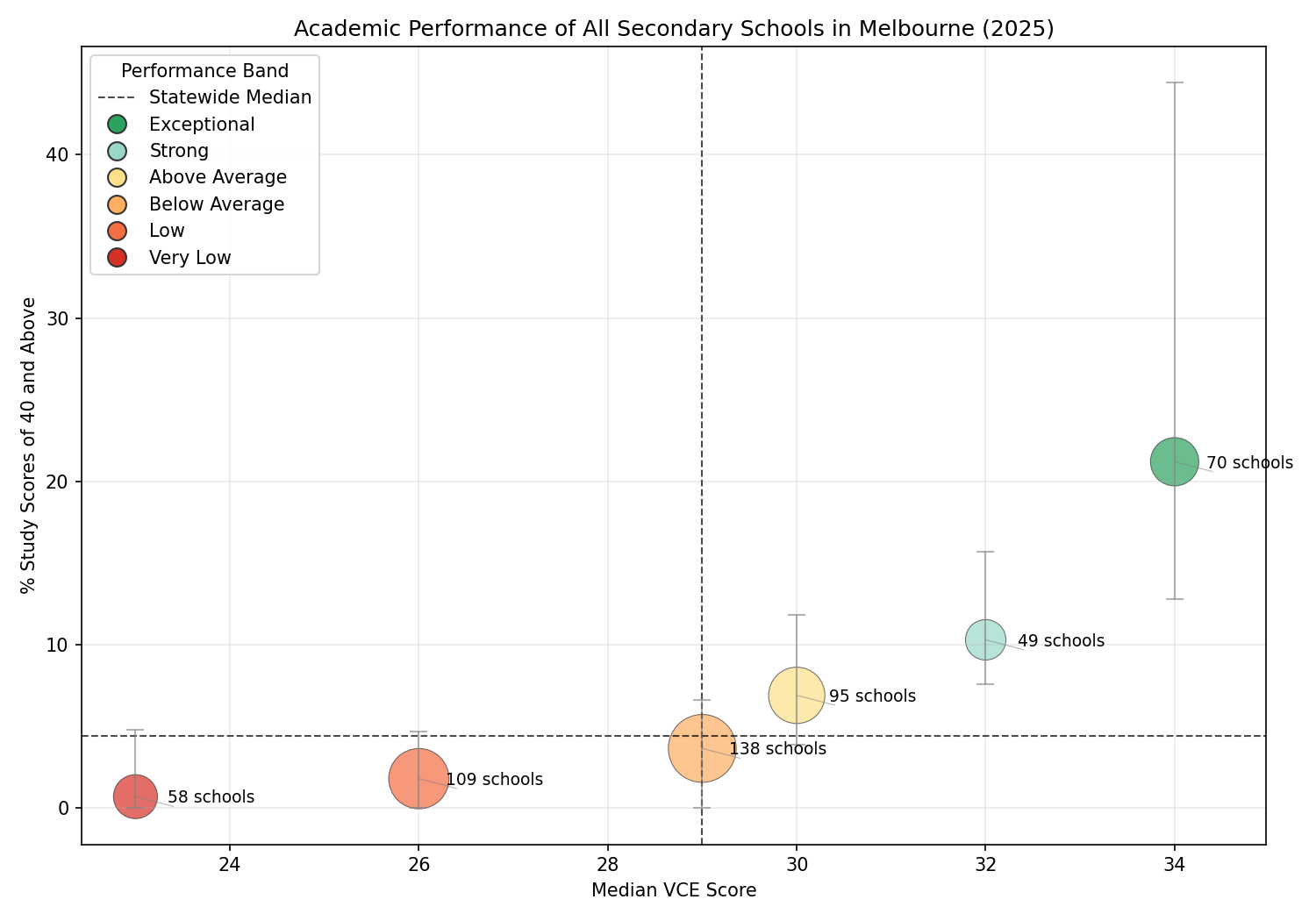
Although the performance bands appear as discrete categories, the underlying data forms a continuous distribution. The cut-offs between bands are based on a statistically robust method (see our method page), ensuring the map colours reflect meaningful distinctions in school performance.
Use this graph as a guide to understand the map colours.
To learn more about how we calculate rankings, the ranking method section below provides a quick overview. For a full explanation of our methods and how we set thresholds for the performance bands, visit out detailed ranking method page.
Ranking Method
Our school rankings are based on two key measures of student performance: the typical achievement of students (median VCE study score) and the proportion of high-achieving students (those scoring 40 and above). To combine these fairly, we standardise each measure into a z-score — a measure of how far a school sits above or below the state-wide average. Schools are then categorised into six performance bands from very low up to exceptional, reflecting increasingly strong academic outcomes. This approach highlights genuinely high-performing schools while remaining statistically robust. For a detailed explanation of our methods and thresholds used, visit our method page.
The numbers behind the ranking we use on our site come directly from the Victorian Curriculum and Assessment Authority (VCAA). All rankings are calculated using our own custom scripts to ensure consistent and transparent results. We update the rankings each year once the latest VCE results are released.
Learn more about how we calculate rankings and use VCE study scores
About VCE Results and Secondary Education in Victoria
The Victorian Certificate of Education (VCE) is the main senior secondary certificate in Victoria, providing an academic pathway for university, TAFE, or work. VCE results measure student achievement and school performance, capturing metrics such as median VCE scores, the proportion of high-achieving students, and overall completion rates.
Additional programs like VCE Vocational Major (VM), VET, HES, and SBAT allow students to gain applied, vocational, or university-level experience alongside VCE. The VCE Baccalaureate recognizes top-performing students, while the Victorian Pathways Certificate (VPC) supports students needing a flexible, foundational pathway.
For university-bound students, the ATAR is derived from VCE study scores, ranking students relative to their peers and influencing course eligibility. Overall, VCE results provide a clear snapshot of academic achievement, readiness for further study, and the effectiveness of a school’s programs.
See this short primer on VCE results and the Victorian Senior Secondary education system for more information.
What Truly Makes a Good School
Once you’ve explored the map, lists, and compared a multitude of schools, take a moment to put it all into perspective.
Rankings tell part of the story — but finding the right school for your child is about much more than data.
If you’re deciding between good secondary schools in Melbourne — whether public or private — consider factors like teaching approach, school culture, and location alongside performance.
For a thoughtful read on what truly makes a good school for your child, see this article by The Conversation:
We often see lists of top schools – but what makes a good school for your child?
Then come back and play around some more because maps are cool!